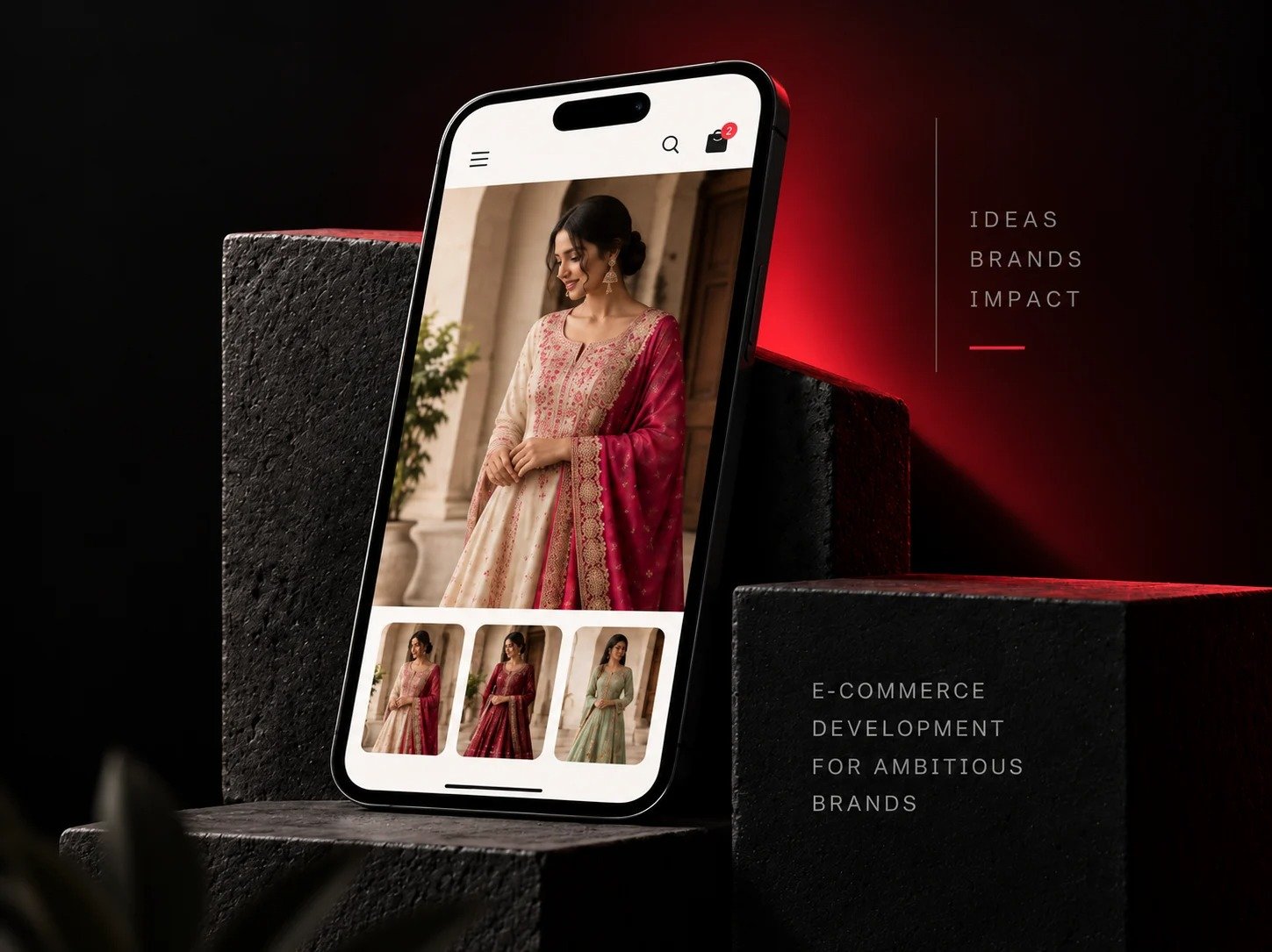
A Shopify store that converts is designed around how your customers buy, not around a template. We design Shopify stores for D2C brands in India and International, from Figma wireframes to a production Liquid theme, with product pages, collection pages, and checkout flows designed to handle paid traffic from Meta and Google Ads.
Metro Home Interiors moved from a basic template to a custom metaobject driven theme and saw 580 percent organic traffic growth in six months with a 6.1x ROAS in the best performing month.
We operate from Ghaziabad, Delhi NCR. Every design project starts in Figma, goes through structured review cycles, and ends with a Shopify theme built to match the approved design exactly.
Same page, three fidelities. Revisions happen at stage 02, where they cost nothing.
Why Store Design Affects What Your Shopify Store Earns
Your Shopify store's design is not decoration. Design is conversion infrastructure. Every design decision on your store directly affects how many visitors become buyers.
1
Product page layout determines whether a shopper scrolls past the add to cart button or clicks it.
2
CTA button placement, size, and colour contrast affect click through rates on every page.
3
Trust signal positioning (reviews, shipping info, return policy) placed above or below the fold changes buyer confidence at the decision point.
4
Mobile navigation depth determines whether a shopper finds what they came for or leaves.
5
Homepage structure decides whether a first time visitor understands what you sell in the first three seconds.
WardrobesKitchensMedia walls4
1
★★★★★ · Free UK delivery · 30 day returns3Book a design visit2
fold5
Metro Home Interiors is a bespoke fitted furniture brand in the UK. The store was running on a basic Shopify template that did not reflect the premium positioning of the brand. After a full design rebuild with a custom metaobject driven theme, Metro saw 580 percent organic traffic growth in six months, 6.1x ROAS in the best performing month, and 67 percent more repeat buyers. The design rebuild was the single biggest change made to the store during that period.
Shopify Store Design Services We Offer
Our Shopify store design services cover seven areas, from full custom builds to theme customization to Figma to Shopify conversion. Each service starts with understanding your brand, your catalogue, and how your customers shop.
Custom Shopify store design means a fully bespoke storefront designed from scratch in Figma and built as a custom Liquid theme. No pre-built template. No shared layouts with other stores. Every section, every page, every interaction is designed for your brand, your products, and your customer journey.
Custom design includes homepage layout, product page architecture, collection page grid and filter design, cart and checkout flow, mobile and desktop versions, and a component library your team can use to update content without needing a developer for every change. Custom design is the right choice for brands that need a storefront reflecting premium positioning or unique product presentation (furniture with 90+ finish options, jewellery with variant combinations, fashion with lookbook layouts).
Shopify theme customization modifies an existing theme (Dawn, Taste, Craft, or any Shopify Theme Store theme) to match your brand identity. This includes custom colour palettes, typography, section reordering, new custom sections, logo placement, homepage banner design, and product page layout adjustments.
Theme customization costs less than a full custom build and works for brands that want a professional looking store without designing everything from scratch. Customization is limited by the original theme's structure. If the theme does not support the layout you need, you move into custom design territory.
Shopify store redesign is a full visual and structural overhaul of a live store without losing your existing product data, customer records, order history, or SEO rankings. Redesign involves new homepage structure, updated product and collection page layouts, improved navigation architecture, refreshed brand visuals, and mobile UX improvements.
Redesign is for stores that launched on a basic setup and outgrew the original design. If your store's bounce rate is climbing, your average session duration is dropping, or your conversion rate has plateaued despite growing traffic, the design is likely the bottleneck.
Product page design covers image gallery layout, variant selector (size, colour, material), add to cart button placement, trust signals (reviews, shipping, returns), cross sell and upsell blocks, and mobile scroll flow. The product page is where buying decisions happen. Every element on this page either moves the shopper toward purchase or creates friction.
Collection page design covers product card layout, filter and sort options, visual merchandising (how products are arranged), pagination or infinite scroll, and category navigation. Collection pages handle traffic from Meta and Google Ads campaigns. If your ad sends a shopper to a collection page with poor filters or confusing layout, you lose the click you paid for.
Mobile first Shopify design means designing for the mobile viewport first and then scaling up to desktop. For Indian D2C brands, 70 to 85 percent of store traffic comes from mobile devices. Designing desktop first and then shrinking elements for mobile creates a compromised mobile experience.
Mobile first design affects navigation depth (how many taps to reach a product), touch target sizes (buttons large enough for thumbs), image loading (optimized sizes for mobile networks), and checkout flow (minimal form fields, autofill support). A mobile first approach is not the same as a responsive theme. Responsive means the layout adjusts. Mobile first means the layout was designed for mobile from the start.
Shopify Plus store design includes everything above plus custom checkout design using Checkout Extensibility. Checkout Extensibility on Shopify Plus allows custom fields, validation logic, branded checkout content, post purchase upsell blocks, and trust badges inside the checkout flow.
Standard Shopify plans limit checkout customization to branding elements like logos, colours, and text. For brands that need a more tailored checkout experience, Shopify Plus development enables advanced solutions through Checkout Extensibility, including delivery preference collection, postcode validation, and conditional logic based on cart contents.
Figma and PSD to Shopify is the service for brands that already have a completed design and need it built exactly as a Shopify theme. You provide the design files (Figma, PSD, Sketch, or Adobe XD). We build the theme in Liquid, matching every layout, spacing, font, and interaction from the design.
Metro Home Interiors provided a prototype design, and we built the production Shopify store to match it exactly. The final store uses a metaobject driven theme architecture where Metro's team updates fabrics, finishes, and product specifications directly from the Shopify admin without touching code. If you have a designer or design agency creating your visuals and need a team to build the Shopify store from those files, this service is the right fit.
Template Setup vs Custom Shopify Design
Template setup and custom Shopify design serve different needs at different price points. This table covers the core differences.
Attribute
Template Setup
Custom Design
Starting cost
₹30,000
₹45,000
Design source
Pre-built theme from Shopify Theme Store
Original design created in Figma, built from scratch
Brand uniqueness
Shared layout with other stores using the same theme
Completely unique. No other store looks like yours.
Layout flexibility
Limited to theme's built in sections and settings
Full control over every page, section, and component
Timeline
1 to 2 weeks
2 to 3 weeks
Checkout customization
Standard Shopify checkout (branding only)
Standard on Shopify plans. Full custom on Shopify Plus.
Best for
Early stage brands, MVPs, tight budgets, fast launches
Growth brands, premium positioning, brands with existing design files
Template setup is the right starting point for brands launching their first store with a limited budget, especially when considering Shopify development costs. Custom design is the right investment when your brand needs a unique storefront that no pre-built theme can deliver, or when your product catalogue requires non-standard page layouts, such as configurators, finish selectors, and multi-variant displays.
Our Design Process
Our Shopify store design process runs in five stages, from discovery to launch. Every project moves through these stages with structured review points where you approve before we proceed.
BriefGrey boxesColour + typeCodeLive
1Written brief, signed offYou approve → next stage
Discovery and Brand Brief
The discovery stage defines what we are building and why. We document your business goals (revenue targets, traffic sources, conversion benchmarks), brand identity (colours, typography, visual language, tone), target audience (who shops at your store and how they buy), product catalogue structure (SKU count, variant types, collection logic), and competitor landscape (what your competitors do well and where they fall short).
The output of discovery is a written brief that both teams sign off on before any design work begins. This brief prevents scope ambiguity, which is the most common cause of project delays and cost overruns.
2Low fidelity layoutsYou approve → next stage
Wireframing and Page Architecture
Wireframing defines the structure and information hierarchy of every key page before any visual design begins. Wireframes are low-fidelity layouts (no colours, no images, no branding) that show where every element sits on the page: header, hero section, product grid, filters, CTAs, trust signals, footer.
We wireframe the homepage, product page, collection page, cart page, and any custom pages your store requires. Wireframing solves layout problems before visual design starts, which saves revision cycles and development time.
3Clickable prototypeYou approve → next stage
Visual Design in Figma
Visual design turns approved wireframes into high-fidelity screens in Figma. This stage adds brand colours, typography, imagery, button styles, hover states, and responsive behaviour (mobile and desktop versions of every page).
We deliver a clickable Figma prototype you can review on your phone and desktop before any development begins. The prototype shows exactly how the store will look and feel. Revisions happen in Figma where changes are fast and cost nothing. Revisions during development cost significantly more because code changes are slower than design changes.
4Liquid, OS 2.0, metaobjectsYou approve → next stage
Shopify Theme Development
Shopify theme development converts the approved Figma design into a production Liquid theme on Shopify. We build with Online Store 2.0 section architecture, which gives you drag and drop control over sections without editing code. Where your product data requires structured storage (specifications, finishes, materials, dimensions), we use metafields and metaobjects so your team manages that data from the Shopify admin.
Metro Home Interiors uses a metaobject driven theme where the Metro team updates fabrics, finishes, and product specifications from the admin panel without developer involvement. This architecture scales with catalogue growth.
590+ mobile PageSpeed target
Testing, Performance, and Launch
Testing covers cross browser validation (Chrome, Safari, Firefox, Edge), mobile device testing (iOS and Android, multiple screen sizes), checkout flow testing (add to cart through order confirmation), and performance validation targeting a 90+ PageSpeed score on mobile.
We launch from a staging environment. The live store switches over with zero downtime. Post launch, we monitor for broken elements, speed regressions, and any issues that appear with real traffic.
What Design Alone Cannot Fix
Design fixes navigation friction, product page conversion bottlenecks, brand credibility, homepage clarity, and mobile usability. These are real problems that a design rebuild solves.
Bad product photography
Design does not fix bad product photography. If your product images are low resolution, poorly lit, or inconsistent in style, a new design will frame bad photos in a better layout. The photos still look bad. Invest in product photography before or alongside a design project.
Weak pricing or poor product market fit
Design does not fix weak pricing or poor product market fit. If your product is priced 30 percent above competitors with no clear differentiation, a new homepage will not change the math. Shoppers compare.
Low traffic
Design does not fix low traffic. A new store design improves conversion rate for visitors who arrive. Design does not generate traffic. Traffic comes from SEO, paid ads, social media, and email. If your store gets 100 visitors per month, a 2x conversion improvement gives you 2 more sales. Traffic comes first or alongside design.
Broken fulfilment
Design does not fix broken fulfilment. If orders ship late, tracking is missing, returns are painful, or customer service is slow, no storefront design will prevent negative reviews and repeat buyer loss.
If your store needs a diagnostic before committing to a redesign, a Shopify store audit identifies whether design, speed, SEO, or something else is the real bottleneck.
Case study · Bespoke fitted furniture · London, UK
How We Designed Metro Home Interiors
Metro Home Interiors is a bespoke fitted furniture brand based in London, UK. Metro designs and installs custom wardrobes, kitchens, media walls, and home office furniture with hundreds of SKU and finish combinations.
The design challenge
For a premium fitted furniture brand, the storefront is the first impression architects, interior designers, and homeowners see. Metro's store was running on a basic Shopify template that did not communicate the premium quality of the brand. The catalogue included hundreds of products across multiple categories, each with dozens of fabric and finish options (90+ finishes across product lines). The existing template could not handle this product complexity. The checkout needed custom lead capture functionality because Metro's products are enquiry based, not add to cart purchases. The brand also needed a design that worked for UK customers expecting a premium buying experience.
What the client brought
Metro provided a prototype design showing the layout, structure, and visual direction they wanted. Our job was to take that prototype and build the exact production store on Shopify.
MetroPrototype design
TBPProduction Shopify store
Metro's teamUpdates finishes from admin
What we built
The production store uses a metaobject driven theme architecture. Metaobjects store fabric types, finish options, product specifications, and room configurations as structured data inside Shopify. Metro's team adds, edits, and removes finishes and fabrics directly from the Shopify admin without touching theme code. This architecture scales as Metro adds new products and finishes without developer involvement for routine updates.
Visual first homepage with high resolution imagery sized for UK broadband speeds
Collection pages organized by room type (wardrobes, kitchens, media walls, offices)
Custom lead capture flow using Shopify Plus Checkout UI Extensions with postcode validation
Mega menu designed for deep catalogue navigation
GTM server side tagging for accurate conversion tracking
Multi-location SEO pages for Metro's UK showroom areas
Industries We Design Shopify Stores For
We design Shopify stores for D2C brands across these industries. Each industry has different product page requirements, catalogue structures, and customer buying patterns that affect design decisions.
Fashion and apparel
Lookbook layouts, size guides, colour swatches, outfit builders, model photography integration, returns and exchange prominence.
Shopify store design projects at The Bright Preneur start from ₹30,000 for project based engagements. Shopify hourly design and development work starts from ₹1,000 per hour.
Project based theme customization, redesignFrom ₹30,000
Hourly design changes, specific page buildsFrom ₹1,000/hr
Every project based engagement includes 1 Year of Free Technical Support after delivery. This covers bug fixes, minor design adjustments, and technical troubleshooting for 12 months after the store goes live. Hourly engagements do not include this. All engagements include NDA coverage, full code ownership transfer, and a dedicated project manager.
Custom Shopify store design typically starts from ₹45,000 depending on catalogue complexity, number of custom pages, and integration requirements.
Why D2C Brands Choose TBP for Shopify Store Design
D2C brands choose The Bright Preneur for Shopify store design because of two capabilities that are difficult to find together at other agencies.
A
We Build What You Designed (Prototype to Production)
If you have a designer, a shopify design agency, or a prototype ready, we build the exact Shopify store from your files. You bring the Figma, PSD, or prototype. We deliver the production store that matches it.
Metro Home Interiors provided a prototype. We built the production store with a metaobject driven architecture that handles hundreds of SKUs and 90+ finishes. The final store matches the client's original design vision exactly.
Most agencies want to control the design process. We work both ways: we design from scratch when you need us to, and we build from your existing design when you have one. Either way, you own the code.
B
Design, Dev, SEO, and Marketing Under One Roof
Your Shopify store design is built by the same team that handles development, SEO, and ongoing maintenance. No handoff to a different agency for implementation. No re-explaining your brand to a new developer. No design intent getting lost in translation between your designer and your developer.
Frequently Asked Questions
Can I pay someone to design my Shopify store?
Yes. Shopify store design is a professional service offered by agencies and freelancers. You can hire an agency like ours to design and build your entire store, or hire a freelancer for specific design tasks. Our project based builds start from ₹30,000.
How much does Shopify store design cost in India?
Theme customization costs starts from ₹30,000. Custom Shopify store design starts from ₹45,000. The cost depends on catalogue size, number of custom pages, and integration requirements.
How long does a Shopify store design project take?
Theme customization takes 1 to 2 weeks. A standard custom design takes 2 to 3 weeks. A Shopify Plus build takes upto 4 weeks. Timeline depends on scope, content readiness, and review cycles. Projects with approved Figma files move faster because the design discovery phase is shorter.
Can you redesign my existing Shopify store without losing data?
Yes. Store redesign preserves all your product data, customer records, order history, and SEO rankings. We rebuild the theme and page structures while keeping your store's data intact. Redirects are set up for any URL changes to protect search rankings.
Do you design Shopify Plus stores?
Yes. Shopify Plus store design includes custom checkout design using Checkout Extensibility. Standard Shopify plans limit checkout customization to branding.
Is mobile design included?
Yes. Every design project is mobile first. We design for mobile viewport first and then scale to desktop. Mobile and desktop Figma screens are delivered as part of every project. Mobile testing across iOS and Android devices is part of our QA process.
Do I own the code after the project?
Yes. Full code ownership transfers to you on project completion. The Shopify theme, all custom sections, and any custom code we write belong to you. We also provide NDA coverage for every engagement.
What happens after the store launches?
Every project based engagement includes 1 Year of Free Technical Support covering bug fixes, minor adjustments, and technical troubleshooting.
Do I need to provide my own design files?
No. We offer both options. If you have design files (Figma, PSD, prototype), we build from them. If you do not have design files, we handle the entire process from discovery and wireframing through visual design and development.
Can I migrate from another platform and get a new design at the same time?
Yes. We handle platform migration and store design as a combined project. Product data transfer, URL redirect mapping, and new theme design happen together.
Tell us about your store
Bring a Figma file, a prototype, or just the brief. We design from scratch when you need us to, and build from your existing design when you have one. Project based builds start from ₹30,000 and include 1 Year of Free Technical Support.